Wednesday, 23 September 2009

Cool pool!


I have mentioned illuminated plants containers in an earlier post. You may have seen illuminated garden globes: outdoor lamps in a sperical shape, but have you seen the pool globes? They look the same as the garden globes but are low voltage and swimming pool friendly. Needless to say that on no account should you put the mains voltage garden globes or plant containers in or near the water! See them on the slide show at the bottom of the page at:http://www.plantcontainershop.com/illuminated-plant-containers.html

Friday, 18 September 2009

Not only but also...


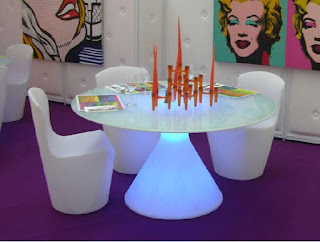
Not only do Lechuza plant containers filter and humidify the air ( see previous post), they also light up the world! The lighting is a low energy, mains powered, led installation that can be arranged in any configuration. The illuminated plant containers are based on the Cubico 400x750 and 300x560 models but can be made from other types of Lechuza container and indeed most plant containers that have a flat side.


You can see other illuminated plant containers and even illuminated seats and tables here: http://www.plantcontainershop.com/

Lechuza AirClean planter and humidifier


Lechuza plant containers are made by the people that produce high quality Playmobil toys. Lechuza has just added another excellent product to the range. It’s a combined plant container, air filter and humidifier.

Humidifiers are used to increase the relative humidity in a room. Raising the humidity can relieve irritating symptoms such as a dry throat, nose or skin. With the winter weather looming, the heating indoors can reduce the humidity especially with the use of convector heaters.

The Lechuza AirClean has a water reservoir of around 28 litres and with the aid of a pump, draws air through moist zeolite based granules. Zeolites are medical grade adsorbants and are used to produce pure oxygen by acting as a microporous sieve. The air takes in moisture as it passes though the granulate and releases it in to the room. Fine dust particles are captured within the granules.

The water reservoir only needs refilling every 4-10 days and the high humidification output can be up to 7 litres a day.

One unit is recommended for a room of at least 40 square metres and will need a mains electricity supply. They are for indoor use only.

It is also recommended that hydroponic plants are used or plants that have had all the soil washed from the roots. Hydroponics are not commonly used in the UK but are readily available if required. Very tall plants are not recommended due to stability issues.

A selection of available hydroponic plants are as follows: Sanseveria, Rhaphis, Aglaonema, Yucca, Zamioculcas and Dracaena fragrans.

Thursday, 10 September 2009

Intensive care

Occasionally I am shown a plant in very poor condition and asked “What can I do with it?” My immediate reaction is to suggest throwing it in the bin but I have realised over the years that people get attached to a plant. Some cases I have seen are terminal. There are other cases that would pull through with some intensive care but hey, why not just go and buy another. Oops, sorry, there’s me being insensitive again. I try to suggest a remedy but I don’t hold much hope.

I suppose it comes from being in the office plant display trade where the customer likes to see plants at their very best. Any plants in an area with poor light will deteriorate over time and before anyone has a chance to say that the plant isn’t looking as good as it used to, it is replaced with a new one. Members of staff will ask whether they can take the old one home but invariably it is left in the office, doesn’t get watered, then dies.

Did I mention that the replacement plant is free of charge? Yes, pay for a maintenance service and the plants are replaced for free. Excluding, that is, those plants that have been accidentally or wilfully damaged or taken for a dance around the office. Yes, a dance. It was such an unusual event that I can still remember from over 20 years ago that it was a large yucca plant. The leading partner probably had his eye poked out by the pointed leaves but didn’t notice because it was a Friday afternoon. At Christmas. Yes, dear readers, he had been drinking alcohol!

Forgetting to water the plant is the most common cause of death. That, followed by a lack of light. The first cause can be remedied with a self watering plant container. The reservoir of water inside the plant container is topped up every couple of weeks and the plant can largely be forgotten. Taking the intensive care theme a bit further, there are designer plant containers with a different type of self watering system. These would be really at home in a hospital reception area as they have a medical type drip feed for the water. This can be adjusted depending on the plant and conditions.

See them on plantcontainershop.com with other designer planters

Thursday, 3 September 2009

It's September, it must be Christmas!

Actually, I meant to write ‘It’s August, it must be Christmas!’ but I am a little late with this blog.

There are groans galore when the first Christmas cards appear in the supermarkets. They are on the shelves before Halloween goodies are in place for 31st October and before fireworks are sold for bonfire night. I’m one of those groaners when I see such products on sale. I just have to mention one thing…

For many years I have associated August with Christmas as that’s when the Christmas goods come in to the wholesalers. The slight difficulty here is that retail customers only decide what Christmas decorations or trees they want in December or at the earliest, November. Most of the trade goods have gone by that time and so choice is more limited. Supplies have to be topped up with some products bought at retail prices. Goodbye profit!

For some deep rooted psychological reasons, Christmas is an unwelcome or unhappy time for a few people. For me, the longer Christmas lasts the better. It goes on for around a whole month in our household. We do, however, limit present giving to the one day. Oh, and the day after.

I can still remember my childhood Christmases when we would wake up before dawn and open up the presents placed in our Christmas stockings. Not the usual pillow case for me and my sister, no, some of my father’s customers had hand made a felt stocking for both of us and attached our initials in a contrasting piece of felt. After opening these presents, we would go downstairs and stare open mouthed at the little piles of presents there. One year one of the presents was a large tent, already assembled in our living room.

In the evening, family members would enjoy the food and drink prepared by my mother. It wasn’t until many years later that I realised that it wasn’t such a lovely time for mum as she was working flat out the whole time! The family would bring presents and there would be another mad unwrapping session. How easy it is to buy a child’s affection with just a few hundred gifts.

Yes, my childhood memories and the joy of watching my own children at Christmas makes this a lovely time of year. Some of my childhood Christmas memories are still crystal clear.

The only drawback of the holiday season is when I am told off for re-arranging some of the Christmas baubles after our children have decorated the tree.

After many years of insisting that we have a real tree, I have recently converted to artificial. The deciding factor came when I bought two trees: one for installation on the 1st December and one to replace this a few days before the 25th so we had a really fresh tree for Christmas day. As I was reinstalling the decorations on tree part two, I thought that maybe this wasn’t such a good idea. Two installations and two removal and disposals. Hmm.

The artificial Christmas tree we have now is really lifelike and has fooled quite a few people. To improve the ambience, I usually stuff some real Christmas tree branches behind the radiators so there is a hint of pine in the air. Of course, that way there are still the traditional needles to clear up, thus ensuring a more realistic experience!

I have used various pots, tubs and barrels for our trees over the years. I like the appearance of the wooden half barrel although this doesn’t retain water. A plastic version of that is better for topping up with water but in a warm environment, it only gives the trees a few extra days life. This year I am going high tech. I will be using a version of the illuminated plant containers. I will, of course, make them available to anyone else who wants them. The seasonal version can be seen at plantcontainershop.com. Merry Christmas!

Monday, 17 August 2009

Versailles planters


The modern interpretation of the ever popular Versailles planter is usually a square shaped wooden plant container with a ball finial on each corner post. Some have an egg shaped finial, which is more in keeping with the original Versailles planter.

In 1661, Louis XIV commissioned landscape gardener André Le Nôtre with the design and laying out of the gardens of Versailles. The works were undertaken at the same time as those for the palace and took forty years to complete. The architect Jules Hardouin-Mansart drew up scenic plans and built the Orangery.

Louis XIV must have had a penchant for orange trees as he amassed a collection of at least a thousand. As they would not survive a heavy frost, the citrus trees had to be planted in moveable boxes or caisses, which were transported to the enormous orangery for overwintering.

Originally, orangeries were simple shelters covering citrus plants that were often planted by a wall. The plants were covered with straw, planks of wood and waterproof sheeting. As the orange tree and other tropical plants became more popular as a status symbols, so the orangeries built to overwinter them became more extravagant. The early purpose built orangeries had an open fire to keep the frost at bay but later versions had their own underfloor central heating.

The caisses originally designed for Versailles were built entirely of timber. They were redesigned in 1820 to include cast iron corner posts. Some of the 1820 style planters lasted for a hundred and fifty years! In 1992 work began on the replanting of the gardens. Inspired by the renovation, three Frenchmen, who had a long association with landscaping and craftsmanship at the palace of Versailles, started to faithfully reproduce the 1820 versions and make them available to the wider world.

Every autumn, the thousand or so trees have to be moved in to the orangery. You can have a virtual tour of the orangery by clicking on the following link. You may need to download some software for this.

http://www.chateau-de-versailles.fr/orangerie/

Once you have seen the orangery, come back to this page and buy the planters! The modern generic Versailles planter is now made in softwood for economy, hardwood for durability, GRP (glass fibre) for longevity and synthetics for economy. The copyrighted reproduction version shown here is only really for gardeners that buy their trowels at Tiffany's. http://www.plantcontainershop.com/.

Wednesday, 29 July 2009

Rope, Sisal, for the use of.


A short while ago I bought a packet of coloured Sisal fibres to add to some office flower displays. I wanted to use the Sisal for support and to add a little something unusual. While trying to separate the bundle in to smaller useable amounts, I was reminded how extremely strong the strands are. Even as small an amount as two or three fibres is very difficult to break by hand and I had to use scissors.

Sisal fibres are very long, often over 1m, and because of this were used historically to make twine and rope. The fibres come from the leaves of a type of Agave, Agave sisalana. They originated in Mexico and were introduced to Florida, the Caribbean islands, Brazil, Tanzania, Kenya, and Asia in the late 19th century. Commercial propagation started in the 1930s.

The fibres are extracted by crushing and thrashing the leaves with the waste pulp being washed away. The waste can be over 95% of the plant material and recently some attempts have been made to improve economic viability with a power plant being developed using biogas from the waste material.

World production of Sisal and a similar agave fibre, henequen, is estimated at around 300 000 tonnes. The major producers are Brazil (120 000 tonnes), Tanzania (30 000) and Kenya (25 000). Brazil exports around 100 000 tonnes of raw fibre and manufactured goods, particularly rope to the USA. Kenya exports around 20 000 tonnes and Tanzania 15 000 tonnes.

Sisal or Manilla rope is traditionally used as tug of war rope. There are rules set by the Tug Of War Association ( yes, there is one!) regarding the use of the rope and how it is held. Nylon should never be used as Tug Of War rope as it stretches and in extreme cases can snap and cause injury. There is a recorded case of two men having their arms cut off by the rebounding force of a nylon rope that snapped during a Tug Of War match.

Agaves make a dramatic display when planted in to the right plant container. Care should be taken when handling the leaves as most have sharp spikes along the edges. In the current health and safety environment I would think that they could cause problems in a garden that has public access unless a large warning sign has been erected nearby!