Friday, 3 June 2011

The whole tooth and nothing but the tooth

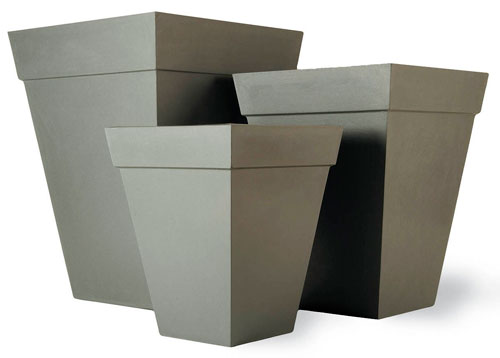
We already have a planter with a water reservoir that looks like a drip used in hospitals and now we have a planter that would be entirely suitable for dentist waiting room: the Moly.  Standard finishes are lead effect and aluminium textured but any colour is available to order.   Sizes 470 dia x 620 tall, 550 x 760 and 750x910.


Another version of an existing planter, the square long pot, now comes in any colour.   Illuminated versions have a low energy lamps or colour changing
remote controlled LED.


A variation on the kanoe planter is now available in a smaller size: 710 long x 290 wide x 490 tall.   The original version is 1800mm long, 680mm wide and 500 or 960 tall.


Spheres now available in any colour.   300, 460, 660 and 1170 diameters and similar sizes in the illuminated version:


Leather planters: tall tapered curved round planters covered in real leather. 360x800, 510x1200, 600x1500.


And the final update of this blog: the Tornado: 530x330, 530x530 and 530x790


Thursday, 2 June 2011

Stainless steel planters with illuminated lettering.

Based on square illuminated planters, these have a stainless steel sleeve placed over the planter with laser cut lettering or a logo on the side.   Image for illustration purposes only.

Why not see them all....

More window boxes available from http://www.plantcontainershop.com/

Available in lead finish, aged lead, terracotta and any BS or RAL colour.


Adam window box 270mm deep, 210mm tall and in 610, 910, 1370 and 1530 lengths.  All colours. 

Bead window box 240mm deep, 220mm tall, two lengths: 610mm, 910mm.

Hunter window box 230mm x 230mm x 910mm.

Oakleaf window box 230mm deep x 240mm tall, two lengths: 610mm and 910mm.

Panel window box in three sizes: 180mm deep x 200mm tall x 760mm long, 230mm x 230mm x 910mm, 200mm x 200mm x 1220mm.


Rectangular window in three standard sizes.   200mm deep 250mm tall and 400/700/1000 long. These can also be any size as a special order.

Swags window box. 200mm deep, 210mm tall and 610/910 long.

Wheatsheaf window box 270mm deep x 210mm tall x 610/910mm.

Tudor window box 220mm deep x 230mm tall x 620mm long

Town window box 220mm x 220mm x 970mm

Beautiful boxes

Why do they discontinue things when they are so lovely?   Because nobody buys them, that's why.   When they are no longer available there's a sudden surge of interest.   "There's no call for them these days, and you're the tenth person I've told that to today!"   The beautiful Piniot window box (1000mm x 220mm wide x 240mm tall) is back by popular demand but only as a special order of four or more.   Any colour you like including lead finish and aged lead finish.


Monday, 9 May 2011

Cameras hidden in amongst stones

A BBC news report states that Network Rail had spent £16.5m to replace stolen electrical cable and compensate train operators for lost service after thieves had removed the cable for the copper.  With scrapyards paying around £ 5000 a tonne, it seems like thieves had struck gold if you see what I mean.   It would take hundreds of metres of cable to make a tonne of copper so the rewards are not that easy to come by.   In order to catch the train track robbers in the act, network rail has installed motion activated cameras amongst the stones and sleepers.   As you can see in the previous post, we now supply smaller artificial rocks, all of which are hollow and can be used to hide a camera or monitoring equipment.   There is even a hollow breezeblock for larger cameras.   Ideal for monitoring building sites and building supply yards.   http://www.artificialrocks.co.uk/


Tuesday, 3 May 2011

A Hollow Mockery

Artificial rocks part two. A new range has been added to the artificialrocks.co.uk website: imitation rockery rocks. As the rocks are suitable for smaller rockeries and as the rocks are mock rocks, and as they are hollow, can a garden feature using these products be called a hollow mockery?


Lightweight artificial water-worn limestone rocks.


Fake limestone pavement.


Artificial limestone pavements.   www.artificialrocks.co.uk.


Discussing the new rocks, my father reminded me that I had started making moulded garden products when I was twelve. In the cornucopia of tools and equipment that was my father’s garage, there was a box full of rubber and silicone moulds. Some of them were for garden gnomes and I set about making a few of them for him to sell to garden centres. I didn’t make many sets before some other project caught my attention and the moulds were literally shelved.

My father also reminded me that he too had made casts using moulds when he was a teenager. He made plaster of Paris windmills, ducks and rabbits for prizes at fairs. There must have been a few left over casts in the box of moulds as I can still see one of the windmills in my mind’s eye with it’s blush of red and green paint. He is sure he still has a small mould somewhere: a rabbit that was for using up the last bit of the plaster of Paris batch. When he finds that mould, we’ll make a rabbit not seen for some sixty-odd years.


Some time ago a customer asked me for a specific type or rockery rock: Westmorland. This is a water worn limestone and is found in limestone pavements, a natural rock feature that resembles a man made paved area. The pavements were created when glaciers exposed horizontally bedded limestone and acid rain eroded the fissures in the slightly water soluble rock. This very attractively shaped rock was extensively used in rockeries and the rare plants that exist in this environment have been threatened by excessive extraction. See more on limestone pavements here: http://www.limestone-pavements.org.uk/index.html


Limestone pavement is now protected by law in the UK and it is an offence to damage or remove it from areas covered by Limestone Pavement Orders. This is where I come in. In the next few months I will be recreating Westmorland style rocks in various sizes. There are already some on the website. Here is one of my early attempts:


The manufacture of fake water-worn limestone will not only protect the limestone pavement environment but also protects the gardener from hernias as he or she tries to manoeuvre the rock in to place.

Tuesday, 22 March 2011

Do people turn round in your driveway?

Some householders are generous folk.   I remember trying to do three point turn in a narrow road and the owner of a house with a gravel driveway informed me that I could turn around in the entrance to his property.   Very kind.   If only the whole world were made up of such kind souls.  The rest of the populace with a similar access to their home don't take to kindly to that type of vehicular behaviour.   Some resort to having some rope tied across their frontage with a couple of dangly bits of plastic hanging from it.   You know the type of plastic, they were used to cordon off roadworks in yesteryear.   I wonder if there is a website for classic roadwork sineage?  There's bound to be.   I digress.   They could place a couple of roadwork cones in the drive. Hmm.   Unattractive.   This is where I drive, sorry, step in.   Coming soon to our website: moulded granite rocks.   You can buy them or hire them for events and exhibitions.


Granite style artificial rocks


One or two of these can be positioned across the entrance and booted out of the way when access is required.   The master cast was taken from a real rock.   One rock but many faces: in the image above they all look different but it's just the way they were placed.  You can also have a salmon pink version and a black version, just in case you feel the need to complement the local stone.

These are different to our glassfibre rocks.   The glassfibre rocks are undistinguishable from the real thing, even at close range.   The polyethelene granite rocks above are very realistic but at very close range you can see some areas where the mould joints were.   The major advantage, however, is that the polyethelene rocks are extremely tough and durable.   If an errant motorist insists on turning round in your drive and these were placed in the way, the car could hit them at considerable speed they would survive intact.   Our more realistic rocks may crack a little.   These are ideally suited for green roofs, exhibitions and private households where access and cost prohibits the use of real rocks.   See them at http://www.artificialrocks.co.uk/